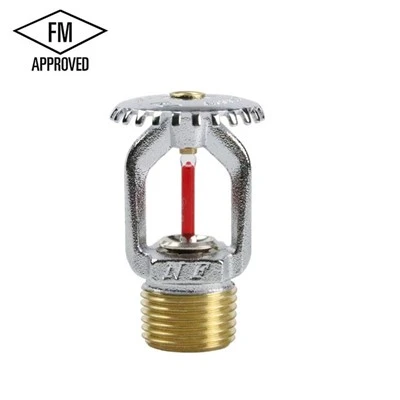
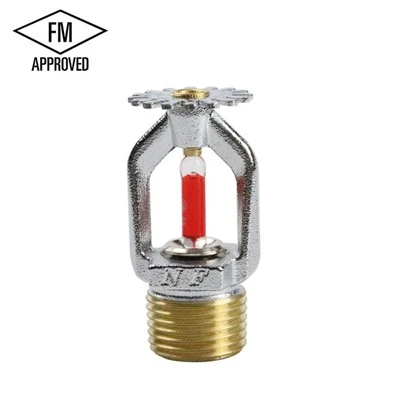
Fire sprinklers are available with different response characteristics to suit different fire protection applications. Two common options are quick response sprinklers and standard response sprinklers. Understanding the difference can help engineers and contractors select the appropriate sprinkler for a specific building and fire protection system.

What Is a Quick Response Sprinkler?
A quick response fire sprinkler is designed to respond to a developing fire more rapidly than a standard response sprinkler under comparable conditions.
Quick response sprinklers typically use a smaller heat-sensitive glass bulb. When the surrounding temperature reaches the sprinkler's rated activation temperature, the bulb breaks and activates the sprinkler.
The faster thermal response can help water discharge earlier during the development of a fire, which is particularly useful in many occupied spaces where early fire control is important.
What Is a Standard Response Sprinkler?
A standard response sprinkler is designed with a different thermal response characteristic and is widely used in various fire protection applications.
Standard response sprinklers are commonly selected for industrial, commercial, storage, and other applications according to the applicable design requirements.
The response classification is only one factor in sprinkler selection. K-factor, temperature rating, coverage area, installation position, hazard classification, and system design must also be considered.
3mm vs. 5mm Glass Bulbs
The glass bulb size is an important difference between many quick response and standard response sprinklers.
A 3mm glass bulb is commonly used for quick response sprinkler designs, while a 5mm glass bulb can be used in standard response designs.
However, bulb size alone should not be used to determine the official response classification of a sprinkler. The complete sprinkler design, testing, listing or approval, and manufacturer's technical documentation should always be checked.
Does Quick Response Mean Better Protection?
Not necessarily.
Quick response sprinklers are designed to respond rapidly, but this does not mean they are suitable for every application. The sprinkler must match the building occupancy, hazard classification, installation conditions, and applicable fire protection requirements.
For example, a quick response sprinkler may be appropriate for certain light or ordinary hazard occupancies, while another application may require a standard response sprinkler or a specialized storage sprinkler.
How to Choose the Right Sprinkler?

When selecting between quick response and standard response sprinklers, consider:
Hazard classification
Building occupancy
Ceiling height
Required coverage area
K-factor
Temperature rating
Sprinkler orientation
Available water supply
Applicable standards
Required certification or approval
The sprinkler's technical data should be reviewed before final selection.
Conclusion
Quick response and standard response sprinklers have different thermal response characteristics and are intended for different applications. A 3mm glass bulb is commonly associated with quick response designs, while 5mm bulbs are commonly used in standard response designs.
The correct choice should always be based on the complete fire protection system design rather than bulb size alone.
NONFIR provides fire sprinkler solutions for different commercial, industrial, and fire protection applications. Customers can provide their required sprinkler type, K-factor, temperature rating, certification requirements, quantity, and project specifications for product evaluation.