Industrial warehouses are changing rapidly. Higher storage racks, automated handling systems, new packaging materials, and increasingly dense storage layouts are creating new challenges for fire protection systems.
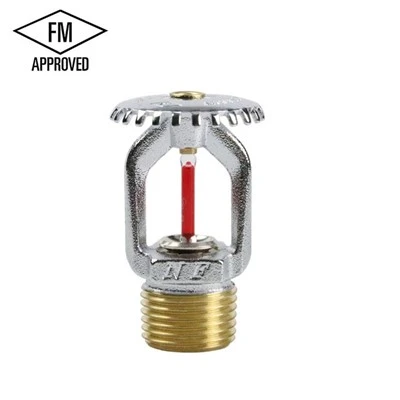
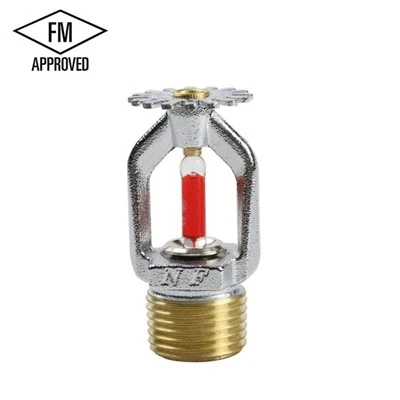
As warehouse environments become more complex, sprinkler selection is also receiving greater attention. FM Approved fire sprinklers are increasingly considered for applications where verified performance and clearly defined installation requirements are important.

Modern Warehouses Are Becoming More Complex
Traditional warehouses were often characterized by relatively simple storage arrangements and manually operated material-handling systems. Today, many facilities use automated storage and retrieval systems, conveyors, high-bay racking, and compact storage configurations.
These changes can influence how a fire develops and how water from ceiling sprinklers reaches the burning materials.
Storage height is particularly important. As products are stored higher, the fire can develop more rapidly and produce stronger heat and smoke movement before sprinkler activation.
At the same time, racks, conveyors, structural members, and other equipment can create potential obstructions to sprinkler discharge.
Why Sprinkler Selection Matters
A fire sprinkler is not simply a water outlet installed above a protected area. Its K-factor, temperature rating, response characteristics, deflector design, installation orientation, and approved application all affect system performance.
For industrial warehouses, sprinkler selection should therefore be based on the actual hazard and storage conditions rather than relying on a general-purpose sprinkler.
Factors that may need to be evaluated include:
Storage height
Ceiling height
Commodity type
Storage arrangement
Building configuration
Sprinkler spacing
Water supply
Hydraulic design
Potential obstructions
Applicable standards and approval requirements
The Role of FM Approved Sprinklers
FM Approval provides a way for fire protection products to be evaluated against defined performance and quality requirements.
For warehouse projects requiring FM Approved equipment, the exact sprinkler model and its approved application should be verified before specification.
An FM Approved sprinkler is not automatically suitable for every warehouse. Approval applies to the specific product and conditions covered by the relevant approval.
This distinction is important when comparing sprinklers that may look similar but have different performance characteristics or approval conditions.
K-Factor and Hydraulic Requirements
The K-factor is one of the key parameters engineers consider when selecting a sprinkler.
In simplified terms, the K-factor describes the relationship between sprinkler discharge flow and operating pressure. Different applications may require different K-factors depending on the hydraulic design.
For example, K5.6 FM Approved sprinklers can be used in applications where their approved characteristics and hydraulic performance meet the project requirements.
However, a larger K-factor should not automatically be considered better. The correct selection depends on the complete hydraulic calculation and the requirements of the specific sprinkler system.
Quick Response and Fire Development
Response characteristics are another important consideration in warehouse fire protection.
A quick response sprinkler is designed to react rapidly to a developing fire when the surrounding temperature reaches its rated operating temperature.
Rapid activation can be particularly important in environments where early fire control is a design objective.
However, response characteristics must be considered together with the sprinkler's approval, coverage, temperature rating, water demand, and intended application.
Storage Configuration Can Affect Protection
Warehouse storage is no longer limited to traditional pallet racks.
Modern facilities may contain:
High-piled storage
Automated storage systems
Rack storage
Conveyor systems
Plastic commodities
Carton-packed goods
Mixed storage configurations
Different storage arrangements can produce different fire challenges.
For this reason, a sprinkler system designed for one warehouse configuration may not necessarily be appropriate for another facility with a different commodity or storage arrangement.
Obstructions Remain an Important Concern
Even a sprinkler with a well-defined discharge pattern can be affected by obstructions.
Lighting fixtures, ducts, beams, conveyors, cable trays, signs, and storage racks can interfere with water distribution.
This is particularly important in automated warehouses, where mechanical equipment can occupy significant space below the ceiling.
During design and installation, sprinkler locations should therefore be coordinated with the building structure and mechanical systems.
Beyond the Sprinkler Head
Effective warehouse fire protection depends on more than the sprinkler itself.
The sprinkler works as part of an integrated system that may include:
Fire pumps
Control valves
Alarm devices
Piping
Water storage
Fire detection systems
In-rack protection
Other specialized fire protection equipment
The final protection strategy should be determined according to the building's hazard classification, storage arrangement, applicable standards, and project-specific engineering requirements.
What Should Buyers Check When Selecting an FM Approved Sprinkler?
For industrial warehouse projects, buyers and engineers should confirm several key details before ordering:
1. Exact Model
Verify the exact model number rather than relying on a general "FM Approved" product description.
2. Approval Status
Confirm that the specific sprinkler configuration is covered by the applicable FM Approval.
3. K-Factor
Make sure the K-factor is compatible with the hydraulic design.
4. Temperature Rating
Select a temperature rating appropriate for the expected ambient conditions.
5. Installation Orientation
Confirm whether the sprinkler is approved for pendent, upright, sidewall, or another specified installation orientation.
6. Application and Coverage
Check the approved coverage area, spacing, ceiling conditions, and other installation limitations.
7. Technical Documentation
Review the manufacturer's technical data and installation requirements before final specification.
Looking Ahead
As warehouses continue to evolve, fire protection systems will need to keep pace with changing storage methods and building technologies.
Higher storage densities, automation, and new material-handling systems are likely to place greater emphasis on accurately matching sprinkler performance with the specific application.
This makes product approval, technical documentation, hydraulic design, and correct installation increasingly important.
FM Approved sprinklers can play an important role in industrial fire protection when the selected sprinkler is appropriately matched to the application and installed according to its approved requirements.
Rather than selecting a sprinkler based only on price, size, or appearance, engineers and buyers should evaluate the complete combination of approval, K-factor, temperature rating, response characteristics, coverage, installation conditions, and system requirements.
As industrial warehouses become more sophisticated, carefully engineered sprinkler protection will remain an essential part of warehouse fire safety.