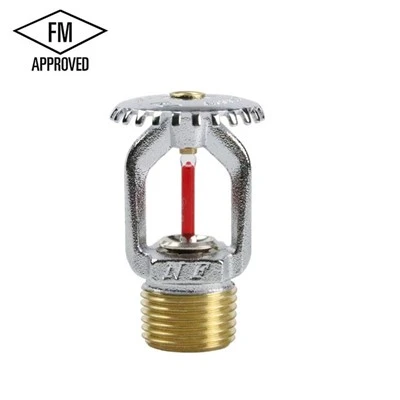
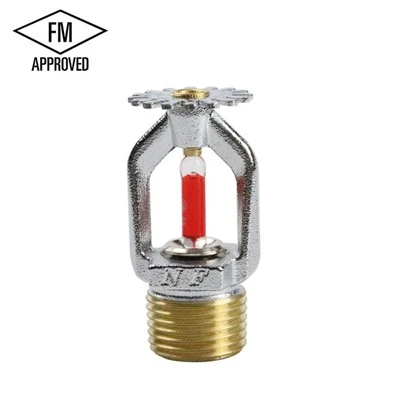
In fire sprinkler systems, the K-factor is one of the most important technical parameters that directly affects water discharge, system design, and fire suppression efficiency. Whether you are a contractor, distributor, or project engineer, understanding the K-factor helps you select the right sprinkler head and ensure compliance with international standards.

What Is the K-Factor?
The K-factor (discharge coefficient) represents the relationship between flow rate and pressure in a fire sprinkler. It indicates how much water a sprinkler can deliver at a given pressure.
Q=KPQ = K \sqrt{P}Q=KP
Where:
Q = Flow rate (GPM or L/min)
K = K-factor (discharge coefficient)
P = Pressure (psi or bar)
In simple terms, a higher K-factor means more water is discharged at the same pressure.
Why Is the K-Factor Important?
1. Determines Water Discharge Capacity
The K-factor directly controls how much water is delivered to control or extinguish a fire.
Small K-factor → lower flow rate
Large K-factor → higher flow rate
2. Impacts System Design
Engineers use the K-factor when calculating hydraulic requirements. It affects:
Pipe sizing
Pump capacity
System pressure requirements
Choosing the wrong K-factor can lead to insufficient fire protection or unnecessarily high system costs.
3. Affects Fire Suppression Performance
Different fire hazards require different water densities.
Light hazard → smaller K-factor (e.g., K5.6)
Ordinary hazard → medium K-factor
High hazard / warehouse → large K-factor
Common K-Factor Values and Applications
| K-Factor | Typical Application |
|---|---|
| K5.6 | Offices, hotels, commercial buildings |
| K8.0 | Industrial facilities |
| K11.2 | Warehouses, storage areas |
| K14+ | High-challenge fire risks |
Among these, K5.6 is one of the most widely used models, especially in standard commercial fire protection systems.
K-Factor and Pressure Relationship (Example)
If a sprinkler has a K-factor of 5.6:
At 1 bar pressure → lower flow
At higher pressure → significantly higher flow
Because flow increases with the square root of pressure, increasing pressure does not double the flow-it increases it proportionally.
How to Choose the Right K-Factor
Selecting the correct K-factor depends on several factors:
1. Fire Hazard Classification
Follow standards such as NFPA to determine hazard levels.
2. System Design Requirements
Consider water supply, pipe network, and pump capacity.
3. Certification Standards
Always choose FM-approved or UL-listed sprinklers to ensure compliance and reliability.
4. Application Scenario
Offices → smaller K-factor
Warehouses → larger K-factor
Industrial risks → high-capacity sprinklers
K-Factor vs Orifice Size
The K-factor is closely related to the sprinkler orifice size:
Larger orifice → higher K-factor
Smaller orifice → lower K-factor
However, performance also depends on design and certification, not just physical size.
Industry Insight: Why K5.6 Is So Popular
K5.6 sprinkler heads are widely used because they offer:
Balanced water flow and pressure requirements
Compatibility with standard piping systems
Cost-effective installation
They are ideal for most commercial and light industrial applications, making them a global standard choice.
Conclusion
The K-factor is a critical parameter in fire sprinkler systems, influencing water flow, system design, and overall fire protection performance. Understanding how it works allows engineers and buyers to make informed decisions, ensuring both safety and cost efficiency.
About NONFIR (CA-FIRE)
NONFIR specializes in manufacturing high-quality FM-approved fire sprinkler heads, including K5.6 standard response and quick response models designed for reliable performance in global fire protection systems.
🌐 Website: www.nonfirsprinkler.com
📧 Email: info@nfsprinkler.com
📱 WhatsApp: +86 18160950625
For technical support or product inquiries, feel free to contact us.