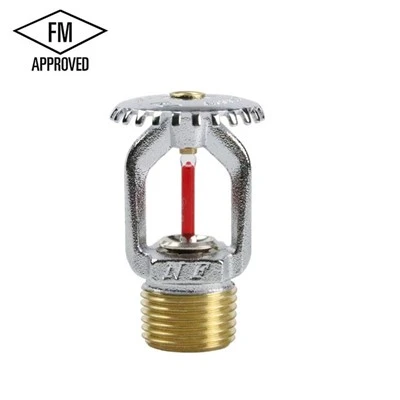
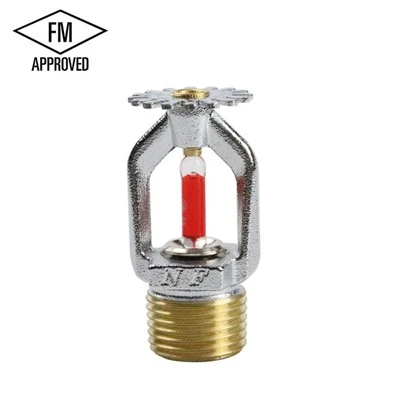
Rapid response fire sprinklers detect high temperatures through thermal sensing elements and activate water discharge. The core mechanism involves a glass bulb or fusible element breaking upon heating, triggering the sprinkler to release water flow.
Temperature-Sensitive Element Trigger Mechanism
Quick-response sprinklers incorporate low-melting-point alloys or glass bulbs. When ambient temperature reaches the preset activation point (e.g., 68°C, 74°C), the element rapidly melts or shatters, releasing the sealing mechanism to open the sprinkler.
Water Discharge Characteristics
High-Flow Discharge: Utilizing high flow coefficients (e.g., K=202, K=363), the water discharge volume per unit time far exceeds that of standard sprinklers, forming a dense water mist that envelops the fire source.
Specialized Droplet Distribution: Ejects larger-diameter droplets with high kinetic energy, penetrating hot air currents to directly impact the combustion surface, rapidly cooling and suppressing flames.
Applications
Primarily deployed in high-risk environments such as high-pile warehouses, logistics centers, and industrial facilities where rapid containment of incipient fires is critical.