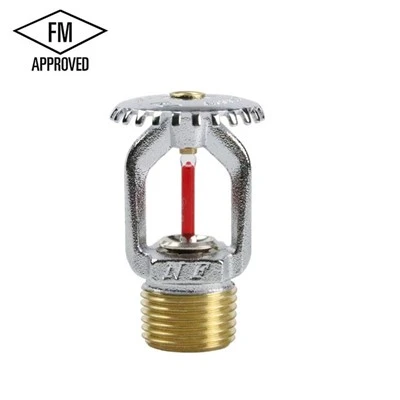
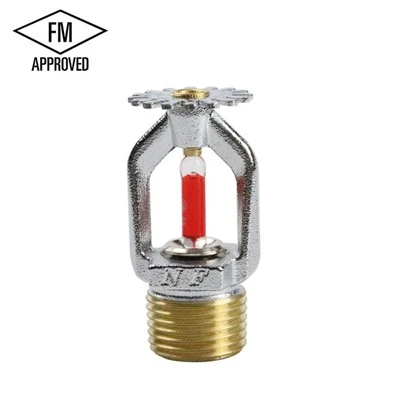
In fire protection engineering and building safety, sprinkler system design is critical. As core components, the selection of sprinkler heads directly impacts fire suppression effectiveness and safeguards lives and property. Sprinkler systems are widely deployed across diverse settings. Overhead and downward-facing heads, as mainstream types, each serve distinct scenarios and must be chosen based on spatial structure, fire risks, and building codes. Understanding their distinctions and application ranges empowers engineers and designers to make more informed decisions and mitigate potential hazards.
Overhead sprinkler heads are typically installed above ceilings or suspended ceilings, with water discharge directed upward or at an upward angle. Water flows through the nozzle and sprays upward, covering the area below. This design rapidly forms a water droplet barrier in high-temperature environments, effectively controlling fire spread. Primary applications include large commercial buildings such as shopping malls, supermarkets, and convention centers. These spaces feature open layouts with high ceilings where fires may originate from overhead or central locations. For instance, in high-rise office buildings with frequent air circulation, overhead sprinklers leverage rising hot air currents to efficiently disperse water mist, extinguishing early-stage fires. Another critical application is industrial plants where equipment density generates heat. The upward spray protects hotspots on machinery, preventing electrical failures from triggering chain reactions. In practice, I designed a sprinkler system for an automotive factory using upward-facing sprinklers in high-temperature furnace zones. Field tests confirmed that installation at 8-meter ceilings covered 40 square meters, significantly reducing response times. However, upward-facing sprinklers have limitations. In spaces with ceilings under 3 meters, water flow may be obstructed by obstacles, leading to uneven coverage. Additionally, in dusty environments like mines, upward spray can cause debris to clog nozzles, requiring regular maintenance. Downward-facing sprinklers, conversely, are typically mounted below ceilings or on walls, directing water downward toward the fire source. This design excels in low-ceiling or densely obstructed areas, enabling rapid fire point access. Primary applications include residential buildings like apartment complexes and villas. Since residential fires often originate at ground level-such as kitchen oil pan fires or living room furniture ignitions-downward-facing sprinklers instantly cool surfaces by spraying directly downward. Another common application is in medical facilities and nursing homes, where compact spaces and mobility-impaired individuals exist. Downward-facing sprinklers prevent water spray from scattering and injuring people while minimizing water mist damage to electronic equipment. For instance, in a community hospital renovation project, we selected downward-facing sprinklers for patient rooms. Through simulated fire tests, they covered the central area of the room within 15 seconds after a fire outbreak, proving particularly effective against mattress fires. Downward-facing sprinklers are also ideal for hotel corridors and educational institutions like schools, where high personnel density requires precise fire source targeting to minimize false activation risks. However, their drawback lies in limited coverage for large spaces; in open-plan offices with ceilings exceeding 5 meters, water dispersion may weaken extinguishing effectiveness. Proper spacing must be ensured in accordance with building codes like NEPA13 standards.
Comparing their respective applications, overhead and downward-facing sprinklers each offer distinct advantages. Overhead sprinklers excel in high-ceilinged areas dominated by hot air currents, while downward-facing sprinklers prove more reliable in low-ceilinged, densely populated zones. Practical selection requires multifaceted consideration: first, assess the building structure by measuring ceiling heights and obstacle layouts; second, analyze fire source characteristics, such as common combustible materials; finally, conduct risk assessments in accordance with local fire regulations. Integrated designs often combine both sprinkler types. For instance, in multi-level shopping malls, downward-facing sprinklers address high-traffic zones on lower floors, while upward-facing sprinklers mitigate risks in large open spaces on upper levels. Based on extensive professional experience, neglecting this distinction leads to resource wastage and safety vulnerabilities. Proper configuration enhances system reliability, safeguards public safety, and ultimately achieves efficient prevention.