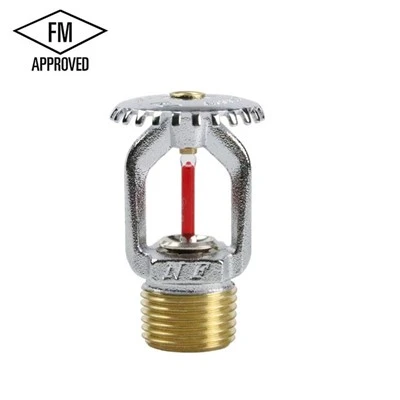
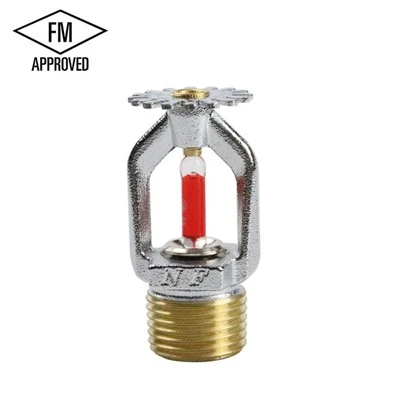
Fire sprinklers are designed to control or suppress fires by delivering water at a specific flow rate and spray pattern. Among the many technical specifications of a sprinkler head, the K-factor is one of the most important. It directly influences how much water is discharged at a given pressure and plays a critical role in fire protection system design.
Whether you are an engineer, contractor, distributor, or building owner, understanding the K-factor helps ensure that the selected sprinkler meets the requirements of the protected occupancy.

What Is the K-Factor?
The K-factor is a hydraulic coefficient that indicates the relationship between water flow and water pressure through a sprinkler.
A higher K-factor allows more water to flow through the sprinkler at the same operating pressure, while a lower K-factor delivers less water.
The K-factor is determined by the internal design of the sprinkler's orifice and frame.
Why Is the K-Factor Important?
Selecting the correct K-factor affects the overall performance of a fire sprinkler system in several ways.
Water Flow Capacity
The K-factor determines how much water is discharged during operation. A sprinkler with a larger K-factor can provide higher flow rates, making it suitable for protecting larger or higher-hazard areas.
System Pressure Requirements
Using a larger K-factor can often reduce the required operating pressure, improving hydraulic efficiency and potentially lowering pump demands.
Fire Control Performance
Proper water distribution is essential for controlling fire growth. Choosing the appropriate K-factor helps ensure adequate cooling and fire suppression.
Hydraulic System Design
Engineers calculate pipe sizes, pump capacities, and water supply requirements based on the selected sprinkler K-factor.
Common K-Factors Used in Fire Protection
Different applications require different sprinkler capacities.
| K-Factor | Typical Application |
|---|---|
| K2.8 | Residential fire protection |
| K4.2 | Light hazard occupancies |
| K5.6 | Commercial buildings and offices |
| K8.0 | Warehouses and industrial facilities |
| K11.2 | High-piled storage |
| K16.8 | High-challenge industrial applications |
| K22.4 | Large warehouses and storage protection |
Among these, K5.6 is one of the most commonly used sprinkler sizes worldwide due to its versatility in commercial and industrial fire protection systems.
Factors to Consider When Selecting a K-Factor
The correct sprinkler should be selected based on several project requirements, including:
Hazard classification
Building occupancy
Ceiling height
Storage arrangement
Water supply capacity
Pipe network design
Local fire protection standards
Required sprinkler spacing
Professional hydraulic calculations should always be performed during system design.
K-Factor and FM Approved Sprinklers
Many FM Approved fire sprinklers are available in multiple K-factor options to meet different application requirements. Certified sprinklers undergo extensive testing to verify consistent water discharge characteristics, thermal sensitivity, and long-term reliability.
Selecting an FM Approved sprinkler with the appropriate K-factor helps improve confidence in overall system performance while supporting compliance with international fire protection standards.
Maintenance Considerations
Even the correct K-factor cannot ensure reliable protection if sprinklers are poorly maintained.
Regular inspections should include:
Checking for physical damage
Removing dust or paint contamination
Verifying proper installation
Inspecting for corrosion
Replacing damaged sprinklers
Following periodic inspection requirements
Routine maintenance helps ensure sprinklers perform as intended during a fire emergency.
Conclusion
The K-factor is one of the most critical specifications when selecting a fire sprinkler. It influences water flow, system pressure, hydraulic calculations, and overall fire suppression effectiveness. Understanding how the K-factor affects system performance enables engineers and contractors to make informed decisions and design safer, more efficient fire protection systems.
As fire protection standards continue to evolve, choosing high-quality, certified fire sprinklers with the appropriate K-factor remains essential for protecting lives, property, and business operations.